
 By sharp sun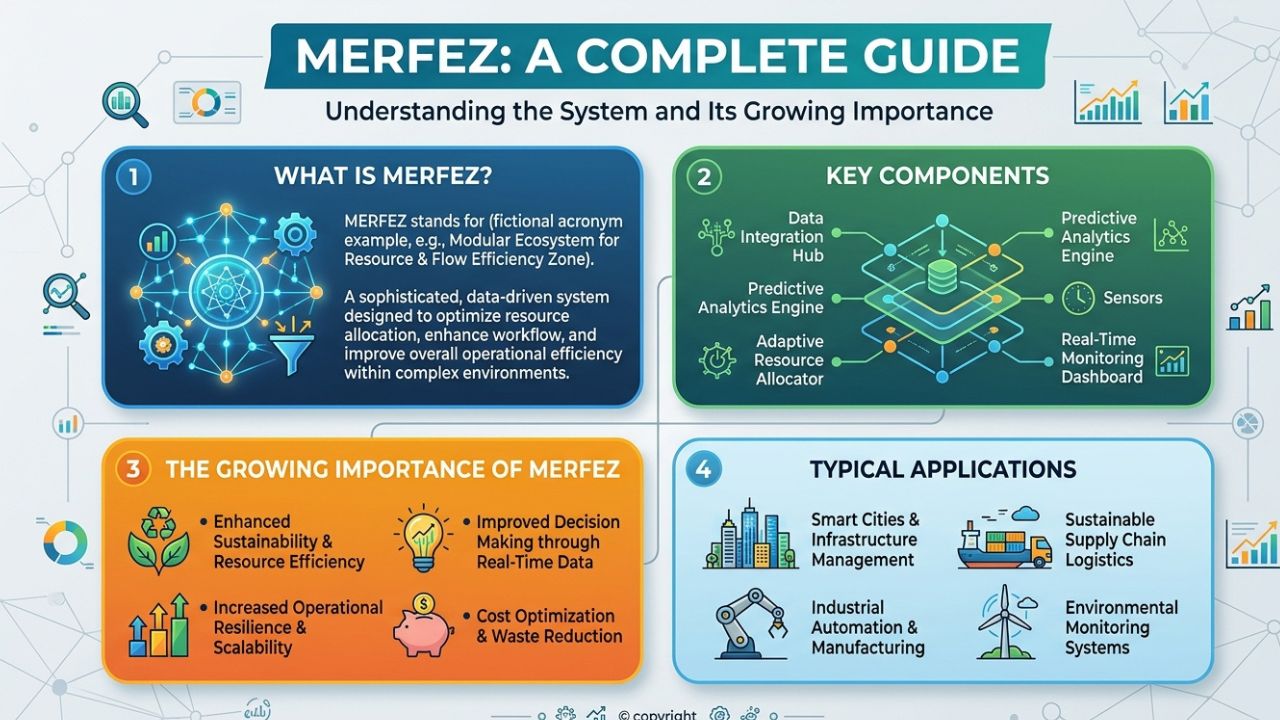
Merfez is a concept that is increasingly being discussed in modern informational and analytical spaces due to its flexible and evolving nature. Although the meaning of Merfez can vary depending on context, it is generally associated with structured systems, organized approaches, and improved efficiency in different processes. As industries and digital environments continue to expand, Merfez has started to represent a useful idea for simplifying complexity and improving overall performance. This article provides a detailed overview of Merfez, its key characteristics, applications, benefits, and challenges, helping readers gain a clear understanding of the topic.
Understanding the Concept of Merfez
The concept of Merfez is best described as a structured framework or approach that focuses on improving order, clarity, and productivity in various systems. It is not limited to a single industry or discipline, which makes Merfez a flexible and adaptable idea.
In simple terms, Merfez can be seen as a way of organizing tasks, ideas, or processes in a logical sequence to achieve better results. This can apply to business environments, educational systems, technological frameworks, and even personal productivity methods. The strength of Merfez lies in its ability to simplify complex structures and make them easier to manage.
As more people look for efficient solutions in a fast-moving world, Merfez continues to gain attention as a useful conceptual model.
Core Principles of Merfez
Merfez is built on several core principles that define how it functions and why it is effective in different situations. One of the most important principles of Merfez is organization. It encourages breaking down large and complicated systems into smaller, manageable parts.
Another key principle of Merfez is efficiency. The idea is to reduce wasted time and effort by creating streamlined processes. This ensures that tasks are completed in a more direct and effective manner.
Flexibility is also a major part of Merfez. Since it is not limited to one field, it can be adapted to different environments without losing its effectiveness. Whether applied in technical systems or administrative tasks, Merfez maintains its core structure while adjusting to specific needs.
Finally, consistency is an essential principle of Merfez. It ensures that results remain stable and predictable over time, which is important for long-term success.
Key Characteristics of Merfez
The characteristics of Merfez help distinguish it as a structured and useful approach. One major characteristic is scalability. Merfez can be applied to both small tasks and large systems without losing effectiveness.
Another characteristic is clarity. M erfez focuses on reducing confusion by creating clear steps and structured methods for completing tasks. This makes it easier for individuals and teams to follow processes without misunderstanding.
Mer fez also emphasizes adaptability. In changing environments, systems often need adjustments, and M erfez allows modifications without disrupting the entire structure.
Additionally, Me rfez supports problem-solving by encouraging logical thinking and systematic analysis. This helps in identifying issues more effectively and finding practical solutions.
Merfez in Practical Applications
Mer fez can be applied in many real-world areas, making it a versatile concept. In business environments, Mer fez is often used to improve workflow management, enhance team coordination, and optimize operational processes. Organizations that adopt structured approaches similar to M erfez often experience better productivity and reduced inefficiencies.
In education, Me rfez can help structure learning materials and teaching methods. It allows students to understand complex subjects by breaking them into simpler components. Teachers can also use Me rfez principles to organize lesson plans more effectively.
In technology, Mer fez plays an important role in system design and software development. Developers can use its structured approach to divide projects into smaller modules, making coding and debugging more efficient.
Project management is another area where M erfez proves useful. By applying Mer fez principles, project managers can plan tasks, assign responsibilities, and track progress more effectively. This leads to better coordination and successful project completion.
Benefits of Using Merfez
The benefits of Merf ez are significant and apply across multiple fields. One of the main benefits is improved productivity. By organizing tasks more effectively, individuals and organizations can accomplish more in less time.
Another benefit of Merf ez is better decision-making. When information is structured clearly, it becomes easier to analyze situations and choose the best course of action.
Mer fez also reduces confusion and errors. A structured system minimizes misunderstandings and ensures that tasks are completed correctly.
Time management is another advantage of Mer fez. By following a clear sequence of steps, unnecessary delays can be avoided, leading to faster results.
In addition, Merfe z enhances collaboration. When teams follow a structured system, communication becomes smoother and more effective, reducing the chances of conflict or misinterpretation.
Challenges Associated with Merfez
Despite its advantages, Me rfez also comes with certain challenges. One of the main challenges is the learning curve. Individuals who are not familiar with structured systems may find it difficult to adapt initially.
Another challenge is resistance to change. Many organizations already have established systems, and introducing Merf ez may require significant effort and training.
Improper implementation can also reduce the effectiveness of Me rfez. If the structure is not followed correctly, it may lead to confusion instead of clarity.
Additionally, over-structuring can sometimes limit flexibility if not managed properly. It is important to maintain a balance between structure and adaptability when applying Merf ez.
Future Potential of Merfez
The future of M erfez looks promising as more industries focus on efficiency and structured systems. As technology conti nues to advance, Mer fez may evolve into more advanced models that integrate automation and artificial intelligence.
In the future, Merf ez could play a key role in data management, digital transformation, and intelligent system design. Its principles may be combined with modern tools to create more powerful and efficient frameworks.
As global systems become more complex, the need for structured approaches like M erfez will likely continue to grow, making it a relevant concept for years to come.
Conclusion
Mer fez is a flexible and structured concept that focuses on improving organization, efficiency, and clarity across different fields. From business and education to technology and project management, Me rfez offers valuable principles that help simplify complexity and improve performance.
While there are challenges in adopting Mer fez, its benefits make it a useful approach for modern systems. As industries continue to evolve, Me rfez is expected to play an increasingly important role in shaping efficient and well-organized processes.